Global Campaign
to Stop Executions
in Iran
The Global Campaign to Stop Executions in Iran is a movement dedicated to protesting every execution in Iran and increasing global awareness of the Islamic Republic of Iran’s killing machine. Our goal is to make every life sentence in Iran increasingly costly for the Islamic regime and ultimately to end the practice of capital punishment. We oppose all forms of execution in Iran, whether they are justified under Sharia Law, used as a pretext for combating drug smuggling, or applied to political dissent. We seek to abolish the death penalty in Iran forever.
09 December 2025
Joint Statement Submitted to the Members of the United Nations General Assembly
Regarding the Human Rights Situation in the Islamic Republic of Iran
Your Excellencies,
We, the undersigned organizations, write to you with deep respect for the essential role of the General Assembly in upholding the purposes and principles of the United Nations Charter, and with profound concern regarding the escalating, widespread, and systematic human rights violations in the Islamic Republic of Iran. We wish to bring to your attention the grave findings contained in three official reports submitted within the United Nations system: the report of the UN Secretary-General, the report of the UN Special Rapporteur on the situation of human rights in Iran, and the report of the Independent International Fact-Finding Mission, all of which have been presented to the relevant UN bodies.
Taken together, these reports, each approaching the situation from a different vantage point yet aligned in their conclusions, provide a deeply disturbing picture of severe and organized patterns of human rights violations. The Independent Fact-Finding Mission has determined that the violations committed by the Iranian authorities, particularly those relating to the violent repression of protests, mass arbitrary arrests, torture, sexual and gender-based violence, extrajudicial executions and enforced disappearances, are at the threshold of, or amount to, crimes against humanity. The Special Rapporteur’s report further substantiates these findings, documenting the persistence and systemic nature of state repression. The Secretary-General’s report highlights the structural and institutional dimensions of these violations and underscores the continued failure of domestic mechanisms to ensure accountability.
The realities reflected in these reports fully correspond to what our organizations witness daily through direct engagement with victims, survivors, political prisoners, and their families. Beyond statistics and legal assessments, we confront the lived experiences of individuals who endure profound suffering and isolation, with no access to justice and no voice to make their pleas heard. The testimonies and documentation we receive show clearly that these violations are not isolated incidents but represent systematic, repeated, and deliberate patterns of conduct affecting millions.
The draft resolution on the human rights situation in Iran, already adopted by the Third Committee, is now scheduled to be brought before the General Assembly. We believe that the international community bears both a moral and legal responsibility to ensure that the resolution is not only adopted but strengthened so that it accurately reflects the gravity and scope of the crisis.
Internationally recognized principles, including the Responsibility to Protect (R2P), which highlights the necessity of collective action in the face of grave and systematic human rights violations, as well as the preventive role of the international community in averting the escalation of humanitarian crises, reinforce the imperative for decisive action. The situation in Iran today, marked by pervasive state violence, acute social fragility, and the risk of broader regional instability, clearly represents a circumstance in which the General Assembly must make full use of its available tools to prevent further deterioration.
For these reasons, we respectfully call upon the General Assembly to:
Adopt, with strong support and strengthened language, the draft resolution concerning the human rights situation in the Islamic Republic of Iran, ensuring that it reflects the findings of all three UN reports, including the determination that certain violations may constitute crimes against humanity.
Recommend that the serious human rights violations in Iran be referred to the Prosecutor of the International Criminal Court for examination, investigation, and potential prosecution, drawing upon relevant UN practice in situations involving prolonged cycles of violence and impunity.
Use the full scope of its mandate to advance international accountability, particularly in circumstances where other mechanisms have been unable to act effectively, in accordance with the UN Charter and the Assembly’s established responsibilities in safeguarding human rights, peace, and security.
Support the creation or renewal of independent mechanisms for fact-finding and evidence preservation, ensuring that documentation of widespread violations is secured for future accountability processes, including potential transitional justice mechanisms or international judicial proceedings.
Reaffirm the need to protect Iranian civil society, including human rights defenders, women’s rights activists, journalists, lawyers, labor activists, and members of particularly vulnerable communities, among them ethnic and religious minorities, and call upon the Government of Iran to take meaningful steps to safeguard their rights.
Call for the immediate release of all political prisoners, an end to executions, and the cessation of violent repression of peaceful protests.
Your Excellencies,
This Joint Statement reflects not only institutional and legal concerns but also the voices of thousands of families who have, for years, been seeking truth, justice, and the support of the international community. We respectfully urge you, ahead of the forthcoming vote, to uphold your collective responsibility to protect human dignity and to ensure that the cycle of violence and impunity does not continue unchecked.
With respect,
Signatory Organizations :
NGOs with ECOSOC Consultative Status :
1. Arc Association for the Defense of Human Rights – ArcDH; Email: [email protected]
2. Zagros Human Rights Center (ZHRC); Email: [email protected]
NGOs without ecosoc consultative status :
3. AFMR – Association for Multicultural Relations
4. AIFA – International Association of Physicians & Healthcare Workers
5. Ahwazi Center for Human Rights
6. Ahwazi Source
7. Alliance for Minority Rights
8. Alliance for Women, Life, Freedom – Florence
9. Alliance for Women, Life, Freedom – Stockholm
10. Associazione Donne Libere Iraniane (Association of Free Iranian Women – Italy)
11. Associazione Maana, Milan Italy
12. Association of Injured & Justice Seekers of the Jina Uprising
13. Alliance of Leftist Women – member are around the world
14. Azadaneh Association – Paris
15. Balochistan Human Rights Campaign (BHRCampaign)
16. Balochistan Human Rights Group (BHRG)
17. Balochistan Woman`s Voice( BRAMSH)
18. Campaign in Defense of Civil & Political Prisoners
19. Campaign to Free Jailed Workers in Iran (Free Them Now)
20. Campaign to Free Political Prisoners in Iran (CFPPI)
21. Collaboration Demonstration Council – Netherlands
22. Committee for Freedom and Democracy in Iran
23. Commite Independent Contre La Repression des Citoyens Iraniens
24. Communist Youth Organization
25. Daughters of Justice Campaign
26. Donna Vita Libertà (Italy)
27. Esmail Khoi Foundation
28. Europerse
29. Ex-Muslim Scandinavia
30. Free Human Germany
31. Free Iran Campaign
32. Free Iran Switzerland
33. Global Campaign to Stop Executions in Iran
34. Hana Human Rights Organization
35. Hanai Rojhelat Organization
36. Human Rights Commission of the Republican & Social Democratic Party of Iran
37. ICAE – International Committee Against Executions
38. IIPHA – International Iranian Public Health Association
39. Independent Committee Against the Repression of Iranian Citizens
40. International Association of Iranian Legal & Political Advocates
41. International Committee Against Executions (ICAE)
42. International Federations of Iranian Refugess
43. Justice Supporters Association
44. Solidarité Internationale pour la Paix -ASIP
45. Iranian Culture & Art Club of Fresno
46. Iran House
47. Iran Protest – Malmö
۴۸. Justice Supporters Association
49. Khavaran 1988 – No Torture, No Execution Movement
50. Khavaran Committee
51. KRF – Women’s Rights Federation (Sweden)
52. Kurdistan Human Rights Reporters Center
53. Kurdistan Justice Seekers
54. Kurdistan Women’s Union
55. Mana Association – Milan
56. National Women’s Rights Association – Sweden
57. Nayer Juristbyra
58. Network of Iranians for Liberty & Democracy
59. NIKA Network – Network of Iranians for Liberty and Democracy
60. NIKA Organization (sister network)
61. No Execution Coalition
62. No to Execution Campaign
63. No to Islamic Republic Group – Orange County, California
64. Rojhalat Women Organization Kordestan Iran
65. Secular Democratic Republicans of Iran
66. Shoraye Bargozaari – Anusheh Group
67. Simorgh Nonpartisan Political and Civil Group
68. Solidarity Human Rights Committee of Republican Democrats
69. Solidarity Network
70. Solidarity Network for Human Rights in Iran
71. Solidarity with Iranians Society, Canada
72. Stop Honor Killings 2020 Campaign
73. The 21st Century Human Rights Association
74. United To End Executions in Iran ( UTEEIRAN)
75. Victims & Justice Seekers of the Jina Uprising
76. Voice of Zagros Network
77. Woman`s Independence and Sustainable Equality ( W.I.S.E)
78. Women, Life, Freedom Association – Nuremberg/Germany
79. Women Life Freedom – Austria
80. Women Life Freedom – Brussels
81. Women Life Freedom Germany e.V.
82. Women Life Freedom Organization– Munich
83. Women Life Freedom Network – Belgium
84. Women’s Revolution Collective
85. Women`s Rights Association
Urgent Appeal — Joint Statement on Escalating Human Rights Violations in Iran
To
Excellencies, Distinguished Members of the United Nations Human Rights Council
The Members of the Third Committee
United Nations General Assembly
New York
Your Excellencies
We, the undersigned — a group of human rights defenders, civil society activists, and families of victims of human rights violations in Iran — express our deepest concern over the intensifying and continuing pattern of organized repression by the Islamic Republic of Iran.
Three years after the beginning of the “Woman, Life, Freedom” movement, the human rights situation in Iran has entered an unprecedented phase of state violence and systematic violations of fundamental rights. While international attention has gradually declined, the Iranian authorities have exploited this silence to launch a new wave of executions, torture, enforced disappearances, and political persecution.
From the beginning of 2025 until the end of September, at least 1,042 individuals have been executed in Iran — placing the country first in the world in proportion to its population. This figure marks a sharp increase compared to previous years: from approximately 580 cases in 2022 to over 975 in 2024, with an upward trend continuing.
The high number of executions in Iran demonstrates a systematic pattern of using the death penalty as a tool of state intimidation and social control. A significant portion of those executed belong to ethnic and religious minorities — particularly Kurds, Baluchis, and Arabs, as well as Afghan migrants. In numerous cases, death sentences have been issued after brief trials lacking minimum fair trial guarantees. Only a fraction of executions are officially announced, while many take place in secrecy. Public hangings have also resumed this year, with several cases of executions carried out in public.
Following the twelve-day armed confrontation between Iran and Israel in June 2025, Iranian security forces exploited the wartime and security atmosphere to intensify domestic repression. During that period, more than 21,000 individuals were arrested nationwide, including civil society activists, journalists, human rights defenders, and dual nationals. Thousands of foreign nationals — mostly Afghan migrants — were also detained on alleged security grounds. The wave of arrests has continued even after the hostilities ended. Many detainees remain subjected to enforced disappearance, with their families unaware of their fate or whereabouts. The risk of torture and execution for these detainees remains acute. Within the one hundred days following the mass arrests, the rate of executions reportedly increased by about 40 percent, averaging four executions per day.
The situation of political and religious prisoners in Iran — particularly in Evin, Qarchak, Fashafouyeh, and Ghezel Hesar prisons — constitutes clear evidence of torture and inhuman treatment. Shortages of medicine, inadequate food, lack of ventilation, overcrowding, unsanitary conditions, and degrading behavior are part of their daily reality. Many prisoners are denied contact with their families, access to lawyers, and medical care.
In response to these conditions, on 13 October 2025, a group of prisoners in Ghezel Hesar Prison (Karaj) launched a hunger strike in protest against the ongoing wave of executions, the inhumane conditions of detention, and the violent conduct of prison officials. The strike was temporarily suspended after several weeks due to the deteriorating health of prisoners and severe pressure from prison authorities. During the strike, many prisoners suffered from extreme physical weakness, loss of consciousness, and significant weight loss. Authorities sought to break the protest by cutting off access to water, medicine, and phone calls. Several strikers were transferred to solitary confinement and beaten, while their families were left without news for weeks. Although the strike has ended, serious concerns remain about the fate of the detainees and the continued use of executions. The hunger strike represented a powerful act of civil resistance against the state’s policy of death. Ignoring its message risks a repetition of atrocities reminiscent of the mass executions of political prisoners in the 1980s.
Torture — both physical and psychological — remains widespread during arrest and interrogation. Methods include beatings, electric shocks, threats of sexual violence, sleep deprivation, and forced administration of psychoactive drugs aimed at physical and mental exhaustion. Deliberate denial of medical treatment and unhygienic conditions have led to the slow death of several detainees. Numerous suspicious deaths in custody indicate that the authorities are deliberately using medical neglect as a means of eliminating dissidents.
In this regard, we respectfully call upon the Third Committee to:
- Address and condemn the widespread executions and the hunger strike in Ghezel Hesar Prison as grave violations of the right to life and human dignity.
- Request the UN General Assembly to take note of the findings of the UN Independent International Fact-Finding Mission on Iran, and call upon the Human Rights Council to renew and strengthen its mandate, while requesting the Secretary-General to ensure the continued transmission of the Mission’s reports to the General Assembly.
- Support immediate, independent, and unhindered access for UN Special Rapporteurs and observers to Iranian detention facilities.
- Encourage Member States to impose targeted sanctions on officials responsible for grave human rights violations.
- Urge Member States and relevant UN bodies to press for an immediate halt to executions, an end to torture, and the release of political and religious prisoners.
- Call on OHCHR and UNVFVT to provide urgent psychological, social, and financial support to affected families.
Today, Iran stands at a critical moment in its modern history — a moment in which the right to life and human dignity is being systematically violated. Silence in the face of these abuses amounts to complicity in the perpetuation of impunity and repression.
With respect and hope for prompt and effective action,
October 28, 2025
The Undersigned
- Arc Association for the Defense of Human Rights and the Democratic/Cultural Demands of the Azerbaijani People of Iran – “ArcDH” (NGO holding consultative status with ECOSOC) – [email protected]
- Lawyers’ Rights Watch Canada (NGO holding consultative status with ECOSOC) – [email protected]
- Zagros Human Rights Center (NGO holding consultative status with ECOSOC) – [email protected]
- 6Rang (Iranian Lesbian and Transgender Network) – [email protected]
- Ahwazi Source – [email protected]
- Alliance for Woman, Life, Freedom – Stockholm – [email protected]
- Alliance of Leftist Woman – [email protected]
- Association of the Woman Life Freedom Movement – Florence – [email protected]
- Balochistan Human Rights Campaign – [email protected]
- Balochistan Human Rights Group – [email protected]
- BRAMSH (Balochistan Woman’s Voice) – [email protected]
- Campaign to Free Political Prisoners in Iran (CFPPI) – [email protected]
- Campaign to Save Political Prisoners and Prisoners Sentenced to Death – [email protected]
- Campaign to Free Political Prisoner in Iran and Author – [email protected]
- Comité Indépendant Contre la Répression des Citoyens Iraniens – [email protected]
- Committee for the Protection of Human Rights in Iran – Köln – [email protected]
- Dadxiazani Kurdistan – [email protected]
- Daughters of Justice – [email protected]
- Esmail Khoi Foundation – [email protected]
- Ex-Muslim in Scandinavia – [email protected]
- Free Iranian Women’s Association – [email protected]
- Free Them Now – [email protected]
- Free_Human – [email protected]
- FreeIran. Switzerland – [email protected]
- Fédération Europerse – [email protected]
- Global Campaign to Stop Executions in Iran – [email protected]
- Group 25 Shahrivar – [email protected]
- HANA Human Rights Organization – [email protected]
- Independent Alliance for Free Iran IAFI – [email protected]
- IIPHA – [email protected]
- International Association of Iranian Legal and Political Advocates – [email protected]
- International Committee Against Executions (ICAE) – [email protected]
- International Federation of Iranian Refugees – [email protected]
- International Solidarity for Peace – ISIP – [email protected]
- Iran Coalition (JANA) – [email protected]
- Global Network to Free Political Prisoners in Iran – [email protected]
- Iran House – [email protected]
- Iranian Culture and Art Club of Fresno, California – [email protected]
- Iranian Teachers’ Union Challenge – [email protected]
- IranProtest – Malmö – Sweden – [email protected]
- Italian Movement Network of Woman Life Freedom – [email protected]
- Justice Supporterà Association – [email protected]
- Khavaran Center – [email protected]
- Kurdistan Women’s Union – [email protected]
- Mahsa Foundation – Copenhagen, Denmark – [email protected]
- MCSD Iran – [email protected]
- Me Too movement Iran – [email protected]
- NAVAWIND – [email protected]
- NIKA, Network of Iranian for Liberty & Democracy – [email protected]
- No to Taboo, No to Violence Against Women – [email protected]
- Rojhalat Women Organization – [email protected]
- SHIVAR – [email protected]
- Simorgh_Berlin – [email protected]
- Solidarity Network for Human Rights in Iran – [email protected]
- Solidarity with Iranian Society – [email protected]
- Stop Honor Killing in Iran – [email protected]
- UTEEIRAN – [email protected]
- Victims & Justice Seekers of the Jina Uprising – [email protected]
- Voice of Iranian Social Democratic Women – [email protected]
- W.I.S.E – [email protected]
- Woman Life Freedom Network Belgium – [email protected]
- Woman, Life, Freedom Group in Gothenburg, Sweden – [email protected]
- Women’s Rights Organization – Kvinnorattsforbundet@gmail.com
Statement of 21 organizations and networks opposed to the Islamic Republic on the occasion of October 10, the World Day Against the Death Penalty
The Islamic Republic’s killing machine must be stopped immediately
While the international community is preoccupied with preventing the Islamic Republic from acquiring nuclear weapons, the regime deploys another deadly weapon on a daily basis: the death penalty.
According to figures from Iran Human Rights, in the first nine months of this year alone the regime has executed more than 1030 people. Such numbers are unprecedented in the past three decades. If this state-organised crime continues at the current pace, executions in Iran by year’s end will account for a large share of the world’s total.
The sharp escalation in executions—up more than 40 per cent since the twelve-day war with Israel—demands that no one remain silent in the face of these state crimes. Now is the time not only to block the regime from acquiring nuclear arms, but also to strip it of its other weapon of terror: execution.
On the occasion of 10 October, the World Day Against the Death Penalty, we call on the international community, international organisations, human rights groups, trade unions, and all progressive and popular forces worldwide to raise their voices louder and clearer against the wave of executions in Iran.
Today in Iran, a battle is underway in which the defence of the right to life and the struggle against executions are central. “Life” has been a core slogan of the Woman, Life, Freedom movement and it continues to be loudly proclaimed. On the third anniversary of the Mahsa revolution, one of society’s dominant discourses was the condemnation of executions and a demand for the trial of those responsible. Prisons have become hotbeds of the struggle against the death penalty; in daily protests, anti-execution slogans resonate; in cities such as Semirom and various cities in Kurdistan, people are going on general strikes to protest the implementation of death sentences. Labour and social organizations speak out openly and boldly against the death penalty. Graffiti bearing the names and photos of those sentenced to death is painted on walls across cities, displaying society’s determination to end this barbarity. An atmosphere of defiance and disgust toward the regime of executions, repression, and plunder is highly palpable in society.
These realities show that despite the surge in executions, the regime has failed to silence society. Each execution sparks not fear but a fresh wave of protest.
Stopping the Islamic Republic’s execution machine is now an urgent priority. The regime sees mass executions and repression as the only way to preserve its rotten rule, while the people of Iran, to defend their lives, see no alternative but to overthrow it. Disabling this machinery of death is achievable—if we can build powerful, united forces nationally and internationally against the criminal regime. Broad-based alliances inside and outside Iran against executions are vital.
The convening of a congress against the death penalty and for the release of political prisoners in Iran – with the participation of activists, human rights organisations, and representatives of political parties – will be an important step forward. Equally vital is broad support for prisoners’ hunger strikes against executions, and for the families of those facing death sentences.
Internationally, we demand more than words of condemnation. Effective action is needed. Diplomatic pressure must be intensified, and European governments must act in concert by recalling their ambassadors from Tehran in protest at executions and repression, and in solidarity with the Iranian people’s struggle. Targeted sanctions must be imposed on the “judges of death” and all officials and institutions directly involved in designing and carrying out execution policies.
On the World Day Against the Death Penalty, let us demonstrate, through united protests and diverse actions, that the people of Iran and the world together demand an immediate halt to executions in Iran and the complete abolition of this inhuman punishment.
September 30, 2025
International Committee Against Executions (ICAE)
Balochistan Human Rights Group
Free Vrishe Moradi Campaign
Free Human
Canadian Iranian Doctors for Human Rights
Network of Iranians for Liberty & Democracy
Campaign to Free Political Prisoners in Iran (CFPPI)
Global Network to Free Political Prisoners in Iran
Global Campaign to Stop Execution in Iran
United Against Gender Apartheid
Iranian Medical Society for Human Rights and Democracy (Berlin Med)
Campaign to Free Jailed Workers in Iran ( Free Them Now)
Kanoon-e Khavaran
International Independent Physicians and Healthcare Providers Association (IIPHA)
Alliance for women, life, freedom- stockholm
United to End Executions in Iran (UTEEIRAN)
Rojhalat Women Organization
Balochistan Cooperation Council
International Association of Iranian Legal and Political Advocate (IAILPA)
Women Revolution
Women Life Freedom Germany e. V.
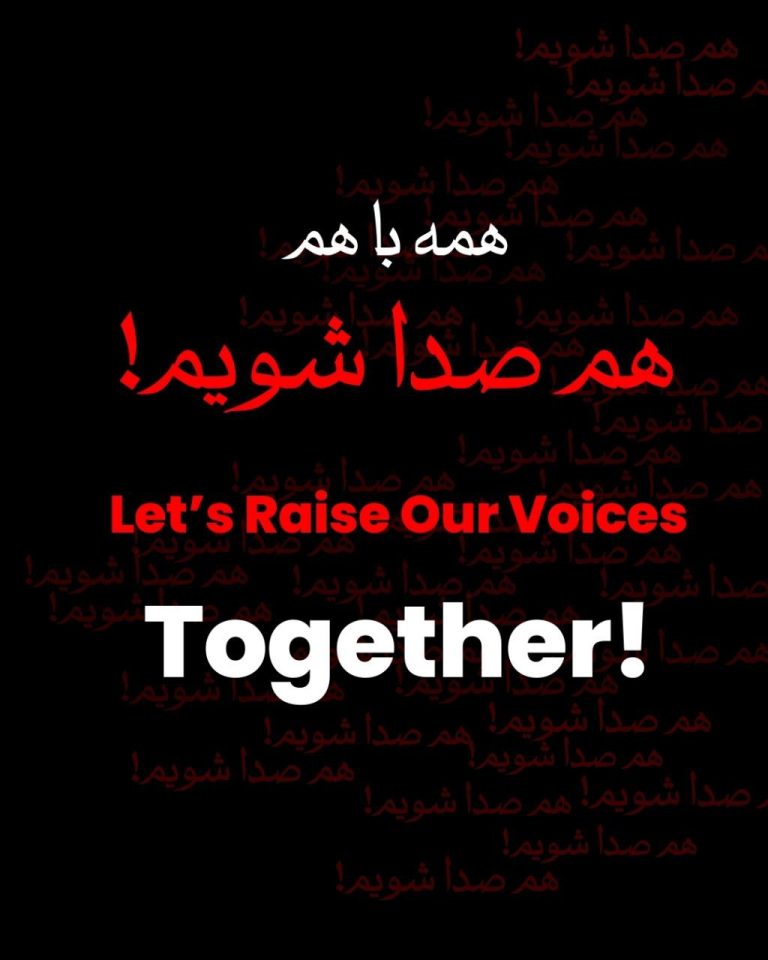
Let’s Raise Our Voices Together!
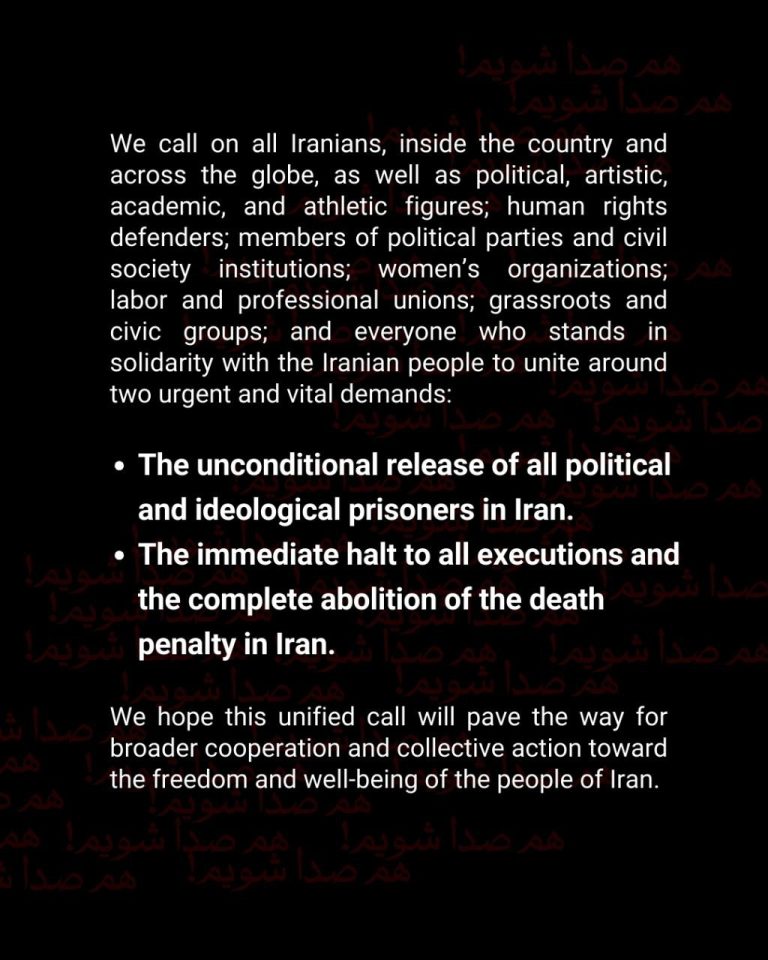
We call on all Iranians, inside the country and across the globe, as well as political, artistic, academic, and athletic figures; human rights defenders; members of political parties and civil society institutions; women’s organizations; labor and professional unions; grassroots and civic groups; and everyone who stands in solidarity with the Iranian people to unite around two urgent and vital demands:
-The unconditional release of all political and ideological prisoners in Iran.
-The immediate halt to all executions and the complete abolition of the death penalty in Iran.
We hope this unified call will pave the way for broader cooperation and collective action toward the freedom and well-being of the people of Iran.
The list of signatories will be updated regularly. The “Let’s Raise Our Voices Together” initiative will be officially published on July 14.
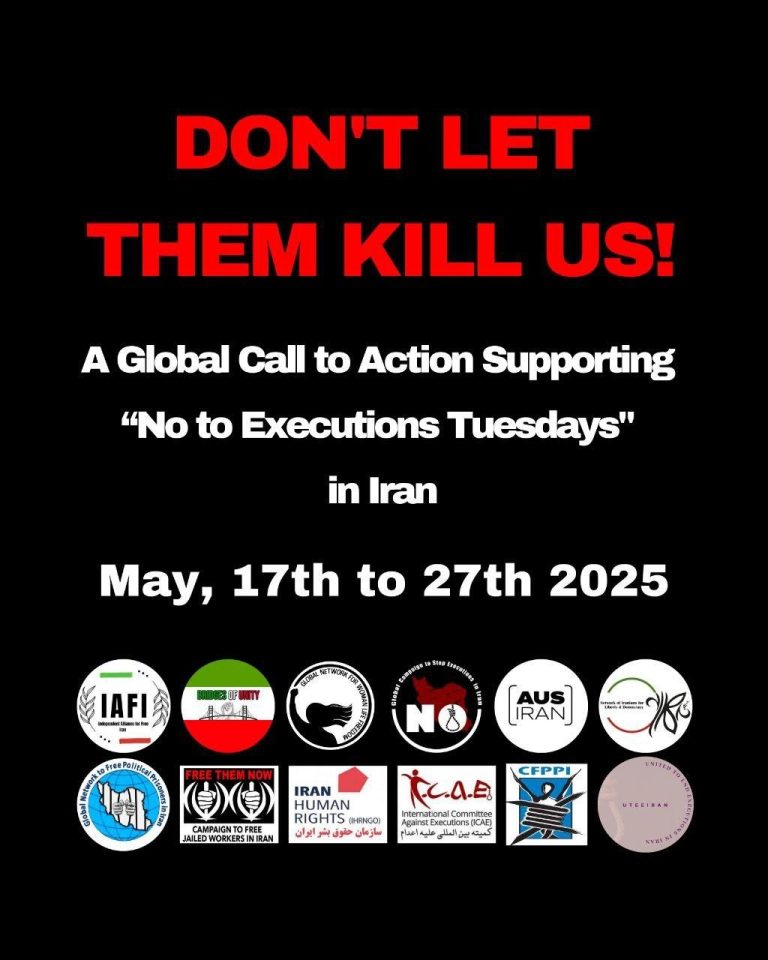
A Global Call to Action Supporting “No to Executions” Tuesdays in Iran
May 17–۲۷, ۲۰۲۵
As negotiations with the United States continue, the Islamic Republic of Iran is unleashing a new wave of executions with bloodstained hands. In just one month, more than 110 people have been hanged. These atrocities are not isolated, they are part of a long-standing policy of repression and state violence aimed at maintaining a crumbling grip on power through fear and death.
To stop the Islamic Republic’s machinery of execution, we must rise in unified protest. We stand in solidarity with Dadkhahan (Justice Seekers), the “Don’t Execute” campaign, and families of death row prisoners, joining this nationwide and global uprising.
We call on all freedom-loving people to take part in this 10-day campaign, marking the anniversary of the execution of the young protesters from the Isfahan House. From May 17 to 27, through street demonstrations, public gatherings, or any form of peaceful protest, we demand the immediate halt of executions in Iran and the full abolition of this inhumane punishment.
This is the voice of prisoners who, every Tuesday from inside their cells, cry out through hunger strikes:
No to Executions.
1. Australian United Solidarity for Iran (Ausiran) 2. Bridges of Unity 3. Campaign to Free the Political Prisonersz in Iran (CFPPI) 4. Campaign to Free Jailed Workers in Iran (Free Them Now) 5. Global Campaign to Stop Executions in Iran 6. Global Network for Woman Life Freedom 7. Global Network to Free Political Prisoners in Iran 8. Iran Human Rights (IHR) 9. International Committee Against Execution (ICAE) 10. Nika, Network of Iranians for Liberty and Democracy 11.The Independent Alliance for Free Iran (IAFIRAN) 12. United to End Executions in Iran (UTEEIRAN)
Follow us on social media!